Smart ingestible pills in 2026: overview
Smart ingestible pills are swallowed electronic or sensor-equipped devices that can report medication ingestion, measure physiology or chemistry, image the gastrointestinal tract, or deliver treatment at a target site. They bring sensing and intervention closer to the biology being measured, while potentially reducing reliance on repeated external sampling or invasive procedures. The engineering challenge is to fit power, sensing, communication and safe passage into a small device, then turn its signals into clinically useful information. The field is broadening from imaging and adherence markers toward active sensing and therapy.
Recent work highlights progress in both device power and localization. In September 2026, Massachusetts Institute of Technology researchers reported an ingestible paper battery for biodegradable medical devices. In August 2026, IMEC, OnePlanet Research Center and the University of Leeds described a sensing capsule localized with a wearable magnetic belt, addressing the need to connect measurements with their position in the gut. Together, these directions point toward more capable capsules that can sense, locate and act; reliable power, precise targeting and clinically meaningful interpretation remain central technical hurdles.
- 1Beyond imaging: Research is extending ingestible capsules from visual examination toward chemical sensing, physiological monitoring and targeted treatment.
- 2Power meets safety: Ingestible and bioresorbable power sources could support more capable devices, but must balance dependable operation with safe passage and degradation.
- 3Location adds context: Magnetic localization can make capsule sensor readings more useful by linking measurements to their position along the gastrointestinal tract.
Top organizations working on smart ingestible pills
Ranked by Linknovate activity score · last 24 monthsThe activity score adds up the relevance of every patent, publication, grant and news item linking an organization to smart ingestible pills. Showing 7 of 311 organizations.
| # | Organization | Approach | Signals (24 mo) | Momentum | Why it matters |
|---|---|---|---|---|---|
| 1 |  Medtronic Inc.
Corporate · United States |
Capsule imaging | NEWS 117 | -66% | Its PillCam product line uses swallowable cameras for gastrointestinal examination, offering a capsule-based alternative to some endoscopic procedures. |
| 2 |  Olympus Corporation
Corporate · Japan |
Capsule imaging | NEWS 56 | -49% | Olympus develops capsule endoscopy systems that capture images of the gastrointestinal tract for diagnostic examination. |
| 3 | C
CapsoVision
Corporate · United States |
Capsule imaging | NEWS 47 | -58% | CapsoVision develops capsule endoscopy products for gastrointestinal imaging, including capsules that capture images as they pass through the digestive tract. |
| 4 | PD
Proteus Digital Health
Startup |
Ingestion event markers | NEWS 66 | -56% | Proteus developed digital pills with an ingestible sensor that signals when medication has been taken, supporting adherence monitoring through a wearable receiver and digital platform. |
| 5 |  IntroMedic Co.
Corporate · South Korea |
Capsule imaging | NEWS 34 | -58% | IntroMedic develops capsule endoscopy systems for gastrointestinal examination, using ingestible cameras to image the digestive tract. |
| 6 |  Massachusetts Institute of Technology
Research · United States |
Sampling and therapeutic capsules | PAT 3 · PUB 17 NEWS 53 |
+70% | Recently, MIT researchers developed an ingestible paper battery for powering biodegradable medical devices; its capsule research also includes long-acting oral drug delivery. |
| 7 |  etectRx Inc.
Corporate · United States |
General | PUB 8 · NEWS 8 | -46% | |
| 8 | ··Hidden organizationCompany | Approach | PAT 00 · PUB 00 GRANTS 0 · NEWS 00 | +00% | Available to registered users. |
| 9 | ··Hidden organizationCompany | Approach | PAT 00 · PUB 00 GRANTS 0 · NEWS 00 | +00% | Available to registered users. |
| 10 | ··Hidden organizationCompany | Approach | PAT 00 · PUB 00 GRANTS 0 · NEWS 00 | +00% | Available to registered users. |
Startups to watch and leading research centers
Startups to watch 4 total
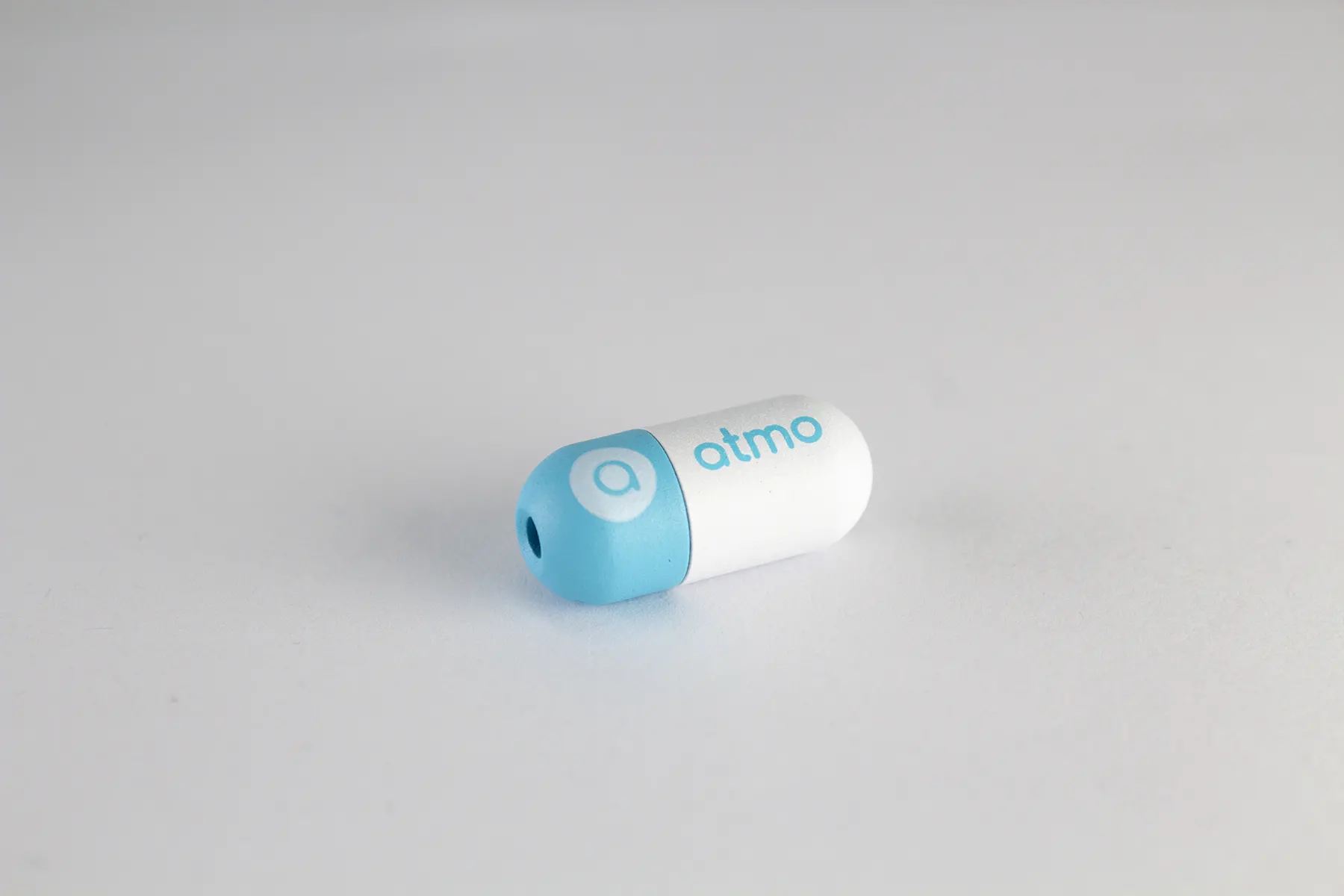 Atmo BiosciencesAustraliaAtmo develops a gas-sensing capsule that measures gut gas biomarkers in real time to support assessment of gastrointestinal disorders and microbiome function.
 EndiatxUnited StatesEndiatx is developing PillBot, a pill-sized robotic device with imaging and propulsion capabilities for remote gastrointestinal examination; its Flower capsule is also being evaluated in a clinical study.
 BiograilDenmarkBiograil is developing an oral capsule for delivering biologics through the stomach wall, offering a potential alternative to injectable administration.
- ··Hidden startupCountryAvailable to registered users, with funding and founding year.
Leading research institutions 265 total
- Massachusetts Institute of TechnologyUnited StatesRecently, MIT researchers developed an ingestible paper battery for powering biodegradable medical devices; its capsule research also includes long-acting oral drug delivery.
 University of Maryland College ParkUnited StatesResearchers at the university study ingestible capsules for localized chemical sensing in the gut, aiming to measure biomarkers relevant to gastrointestinal health.
 Brigham and Women's HospitalUnited StatesClinical researchers have studied digital pills paired with a wrist-worn receiver to assess medication adherence, including in HIV prevention.
- ··Hidden research institutionCountryAvailable to registered users, with their key researchers.
- ··Hidden research institutionCountryAvailable to registered users, with their key researchers.
Where smart ingestible pills innovation happens
Share of documents with at least one organization from each country.
Open the interactive map with all 311 organizationsMain technical approaches
Last 24 months| Approach | What it is | Documents | Leading organizations |
|---|---|---|---|
| Capsule imaging | Swallowable cameras capture gastrointestinal images; they offer minimally invasive examination but depend on image quality and clinician review. | 129 |
Medtronic Inc., Olympus Corporation, CapsoVision |
| Physiological sensing | Sensors measure bodily signals from inside the tract; readings can be continuous or local, but require reliable power and interpretation. | 143 |
Medtronic Inc., Fairfield Market Research, Honeywell |
| Chemical biosensing | Capsules detect chemical markers in gastrointestinal fluids; they can provide local biochemical data but face challenges in selectivity and calibration. | 17 |
Massey University, University of Toronto, University of Auckland |
| Ingestion event markers | An ingestible marker signals that a medication has been taken; it supports adherence monitoring but does not establish correct dosing or clinical benefit. | 59 |
Medtronic Inc., Proteus Digital Health, U.S. Food and Drug Administration |
| Sampling and therapeutic capsules | These capsules collect samples or release treatment at a target site; localization and controlled delivery are difficult in a variable gastrointestinal environment. | 506 |
Medtronic Inc., Olympus Corporation, CapsoVision |
Emerging trends
Last 12 months vs previous 36 monthsTerms whose frequency in the last 12 months grew the most compared with the previous 36 months.
Funding and investment
Recent funding rounds
Grant records total $16,545,382 across 14 grants since 2020. These figures describe recorded grants, not necessarily funding dedicated solely to smart ingestible pill projects.
Patent landscape
Top patent holders · last 24 monthsRecent developments
Latest news, duplicates removed- Oct 2026The decision to age in place used to come down to one question: is this home physically manageable? Today that question has expanded. Medical technology has changed what’s possible in a home environment so significantly…The Healthcare Guys
- Oct 2026Forgetting a dose is one of the most common and most human parts of taking medicine. A pill is skipped in a rush, a refill runs out over a weekend, or a complicated schedule simply slips the mind. Medication adherence…Future Patient
- Sep 2026Typically, if you swallow a battery, it’s a mistake that calls for a trip to the hospital. But that’s not the case with a new ingestible paper battery developed by scientists at MIT. The battery could be used to power…IEEE Spectrum
- Sep 2026A magnesium–molybdenum trioxide battery was tested in the gastrointestinal tract, powering wireless tracking and electrical stimulation while researchers examined how long it could operate and what happened as its…AZoM.com - Materials and Engineering News Feed
- Month 20XXHidden developmentAvailable to registered users with alerts enabled.
Frequently asked questions about smart ingestible pills
What companies are working on smart ingestible pills?
Medtronic Inc., Olympus Corporation, CapsoVision and IntroMedic Co. are prominent companies working on capsule imaging. Proteus Digital Health developed ingestion event markers for adherence monitoring, while Atmo Biosciences works on gas-sensing capsules. The company mix reflects different product paths: gastrointestinal imaging, medication-use confirmation and sensing of conditions inside the gut.
Which smart ingestible pills startups are the most promising in 2026?
Atmo Biosciences, Endiatx and Biograil are the startups listed for smart ingestible pills. Atmo develops a gas-sensing capsule, Endiatx is developing a pill-sized robotic imaging device, and Biograil is developing a capsule for oral delivery of biologics. Their different aims span sensing, examination and drug delivery; the available facts do not establish comparative clinical or commercial success.
Which universities and research centers lead smart ingestible pills research?
Massachusetts Institute of Technology, the University of Maryland College Park and Brigham and Women's Hospital are notable research organizations in the data. MIT works on ingestible batteries and therapeutic capsules, Maryland studies localized chemical sensing, and Brigham and Women's Hospital has studied digital pills paired with a wrist-worn receiver. Their work spans device engineering, sensing and adherence.
How much funding has smart ingestible pills received?
The recorded grant total is $16,545,382 across 14 grants since 2020. This is a grant-based figure, not a complete measure of investment in the technology. The recorded funding rounds include organization-level financing that may not be dedicated to smart ingestible pill development, so they should not be treated as a project-specific investment total.
Who holds the most smart ingestible pills patents?
Stichting Wec Nederland is the leading listed patent holder, with 12 patents. Dexcom and Insulet each have 4, while Massachusetts Institute of Technology has 3. These are the holders with the highest counts in the listed data; the figures identify patent records, not necessarily the commercial importance or current legal status of each invention.
Is smart ingestible pills patent activity growing?
No: the recorded patent activity declined 33.3% in the last 12 months compared with the previous 12 months. The data records 135 patents in the 24-month window. This measure captures a recent decline in patenting, but it does not by itself show whether research, product development or clinical use is advancing or slowing.
What are the latest developments in smart ingestible pills?
In September 2026, Massachusetts Institute of Technology researchers reported an ingestible paper battery intended to power biodegradable medical devices. In August 2026, IMEC, OnePlanet Research Center and the University of Leeds described a sensing capsule with magnetic localization using a wearable belt. These developments address two practical needs: powering devices safely and locating measurements within the gastrointestinal tract.
What are the main approaches in smart ingestible pills and how do they differ?
The approaches are capsule imaging, physiological sensing, chemical biosensing, ingestion event markers, and sampling and therapeutic capsules. Imaging produces visual information; sensors measure bodily signals or chemical markers; event markers record medication ingestion; and sampling or therapeutic devices collect material or deliver treatment. The approaches differ in what they measure or do, and in their requirements for power, localization and interpretation.
Which countries lead smart ingestible pills?
The United States leads the listed country activity with 5,025 documents, followed by the United Kingdom with 1,143 and Japan with 985. Germany, China and Switzerland also appear among the countries with substantial activity. These document counts indicate where activity is recorded, rather than measuring market share or the number of deployed products.
What are the applications of smart ingestible pills?
The listed applications include medication adherence (260 documents), remote physiological monitoring (249), gastrointestinal diagnostics (161), localized gastrointestinal therapy (145), and metabolic and endocrine monitoring (98). These uses range from confirming that a medication was swallowed to imaging, measuring internal signals and delivering treatment. The listed organizations include Medtronic Inc., Olympus Corporation, CapsoVision and Proteus Digital Health.